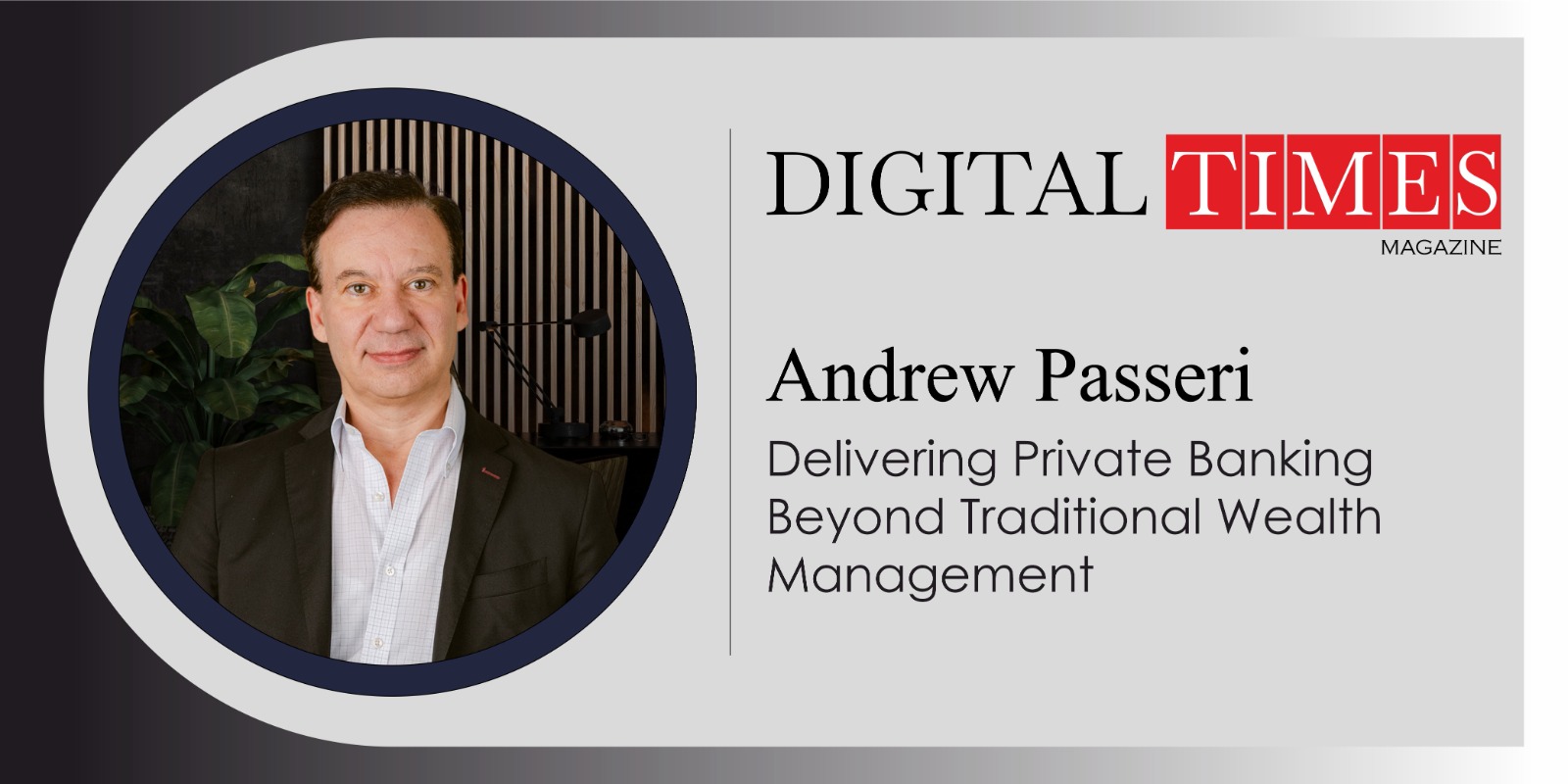
Money often tells only a fraction of the story. Behind major investments, global businesses, generational wealth, and billion-dollar decisions are people searching for certainty during moments that carry enormous financial and personal consequences. Private banking exists far beyond portfolios and transactions. It sits at the intersection of ambition, trust, legacy, and long-term vision. Families building multigenerational wealth require more than technical financial expertise alone. They need advisors capable of understanding the emotional weight behind succession planning, the pressure behind entrepreneurial risk, and the responsibility that comes with preserving opportunity across generations.
This is where Andrew Passeri continues to distinguish himself at HSBC. As Managing Director and Senior Private Banker, Andrew works closely with ultra-high net worth individuals, entrepreneurial families, and Family Offices whose financial lives often span industries, borders, and generations. Over more than two decades, he has built a reputation grounded not simply in financial execution, but in trust, perspective, and long-term relationship building.
The Relationships That Shape a Career
Over the course of two decades at HSBC, Andrew Passeri’s journey in private banking has been shaped not only by markets, transactions, or financial milestones, but by people. For Andrew, the greatest education of his career did not come from textbooks or boardrooms alone. It came from clients, particularly entrepreneurs whose ability to think ahead continually challenged him to grow alongside them.
Long before subjects like artificial intelligence, crypto, blockchain, and commercial space exploration became part of mainstream business conversation, Andrew recalls clients introducing him to these ideas through discussions centered around ambition, investment, and future opportunity. Working closely with visionary entrepreneurs allowed him to evolve alongside industries undergoing rapid transformation.
This constant exposure to innovation shaped not only his understanding of finance but also his broader perspective on leadership, adaptability, and long-term relationship building. For Andrew, private banking has never been simply about managing wealth. It has always been about understanding the people behind it, their aspirations, their businesses, their families, and the future they hope to create.
Leadership Built Through Inclusion
Andrew’s leadership philosophy was strongly influenced by a handful of exceptional mentors and senior leaders he encountered throughout his career. While each brought different strengths to the table, they shared one important quality: they understood that true professional fulfillment comes from inclusion.
The leaders who influenced Andrew most were those who made their teams feel part of the client experience rather than distant observers. They encouraged participation, ownership, and involvement in meaningful decision-making. This left a lasting impression on him and later became central to how he led his own teams.
Throughout his leadership journey, Andrew consistently emphasized that motivation is not driven purely by compensation. In his view, people are energized when they feel trusted, valued, and included in important conversations. Having a seat at the table matters because it creates purpose, accountability, and professional pride.
His leadership approach has helped create remarkable continuity within his team. Many of the professionals who worked alongside Andrew have remained with him throughout much of his twenty-year tenure at HSBC. He believes strong advocacy, transparency, and mutual respect have played major roles in building that long-term loyalty.
Even during demanding periods, Andrew remained committed to supporting his teams while challenging them to grow professionally. For him, leadership has always involved balancing high expectations with genuine investment in people.
Passing Forward the Human Side of Banking
Supporting younger talent remains one of the most meaningful aspects of Andrew’s career. He has consistently taken an active role in mentoring emerging private bankers and helping them develop confidence, commercial instincts, and a long-term perspective.
His advice to younger professionals reflects the same entrepreneurial mindset that shaped much of his own career. Andrew encourages rising bankers to think ahead, recognize future opportunities early, and remain willing to support unconventional but promising ideas.
He believes strong private bankers must be willing to advocate for clients, particularly entrepreneurs whose businesses or financial profiles may not always fit traditional models. In many cases, success comes from recognizing potential before it becomes obvious to everyone else.
At the same time, Andrew places significant emphasis on responsiveness, availability, and kindness. Technical expertise and financial sophistication matter greatly within private banking, but he believes a genuine human connection remains equally important.
For Andrew, mentorship is not about creating identical versions of himself. It is about helping younger professionals build the confidence and judgment needed to navigate increasingly complex client relationships while remaining grounded in empathy and integrity.
Trust Beyond Transactions
The client relationships in private banking can often be characterized as being built around trust, and Andrew understands that trust has to reach beyond just the client. The main factor that contributed to making Andrew successful in his work has been building relationships with the families he was working with as well as with the professionals who were responsible for managing their finances.
Building close connections with Family Office teams, advisors, and decision-makers that surround clients have allowed Andrew to gain an understanding of all the complexity that lay at the bottom of financial problems people had. This approach made it possible for Andrew to consider himself not only as a banker, but also as an integral part of the client’s system of financial management.
Andrew believes that for one to be successful in private banking, he has to be able to understand everything about wealth management in the families he is working with – its operational, psychological, and even generational aspects. Families do not need products; they need experienced consultants that will help them make decisions in various fields.
Earning Trust in Defining Moments
From Andrew’s point of view, the real distinction between a good private banker and a great one is evident in times of crisis, in which a client needs something special.
It is during such times when the level of trust is really challenged. The clients need their bankers for more than the mere technical ability. They need support in the form of confidence, reassurance, and certainty regarding the decisions being made. In his opinion, the opportunity to manage all of this in moments like these is one of the greatest responsibilities in private banking.
According to Andrew, the biggest joys in his work do not come in the course of making transactions, but afterwards, when meeting with clients who thank him for something he had done for them. This allowed them to take their business or family to another level.
Such times bring about the realization that there is far more human emotion involved in finance than people tend to think. Every transaction has its own story related to ambition, family, or growth in some way.
Banking in a Digitally Connected World
Over the years, Andrew has witnessed major shifts in client expectations, particularly around technology and global connectivity. Today’s ultra-high net worth clients expect seamless digital access, international banking flexibility, and integrated financial solutions capable of operating across borders.
For Andrew, HSBC remains unique by virtue of its unique ability to integrate size and digital sophistication. Through HSBC’s vast international footprint, its strong balance sheet, and inter-connected banking operations, customers can carry out transactions and management of finances in different jurisdictions more efficiently.
That being said, Andrew goes on to point out that there are instances when clients look for banking institutions that understand unorthodox financing models and income from around the world. Many entrepreneurs and international businessmen may have financial profiles that fall outside of traditional lending models.
Andrew thinks HSBC excels at such moments. It is its ability to provide solutions for those complex financial cases that makes HSBC unique in many ways.
There have been many occasions when he had clients come to him after having difficulty finding any institution that understood their unique financial profile. It has become very much a part of what Andrew does.
The Calm Behind Critical Financial Decisions
Throughout his career, Andrew has assisted clients during what he would argue were some of the most trying times in recent financial history, from the 2008 financial crisis to geopolitical instability, the coronavirus pandemic, and volatile markets.
In situations such as these, being an expert in technical finance is only one aspect of the job. Clients need emotional stability and clear-minded guidance in order to avoid making irrational decisions which may later bring about regret.
As Andrew sees it, one of the most important duties of a private banker is guiding clients in order to ensure that they stay levelheaded during unstable times. In times of uncertainty, fear can arise, and fear results in poor decision-making. Thus, staying rational during such times is crucial.
Being able to do so has also made the client relations even more trusting.
A Legacy Measured Across Generations
When thinking about career highlights, Andrew emphasizes the significance of big deals, mandate work, and working with ultra-high net worth families. However, there is one milestone that surpasses all others in its personal significance for him.
Nowadays, many of the entrepreneurial families Andrew used to work with many years ago have begun to transition into second and even third generations. Watching young people grow up and still maintaining a connection with HSBC makes his job more significant and meaningful for him.
This type of intergenerational trust is a very significant thing in Andrew’s eyes.
Looking to the future, Andrew is still highly interested in exploring how AI and technological evolution will impact and redefine industries, companies, and even wealth management practices themselves. Having purchased HSBC Innovation Bank has only added fuel to his passion for guiding Family Offices through the next wave of technological evolution.
Nevertheless, although there have been numerous breakthroughs in the development of AI and automation, Andrew is firmly convinced that private banking will always entail a human component. While technology can increase efficiency, understanding, and accessibility, no algorithm can replace real human discussions about family, legacy, trust, and long-term vision.
Underpinning Andrew’s approach to finance is a profound conviction that wealth, wisely managed, holds the power to change lives for the better. In the years to come, he envisions the need for continuing to foster inclusive workspaces where diversity in talent and experience could drive more positive results for everyone involved.