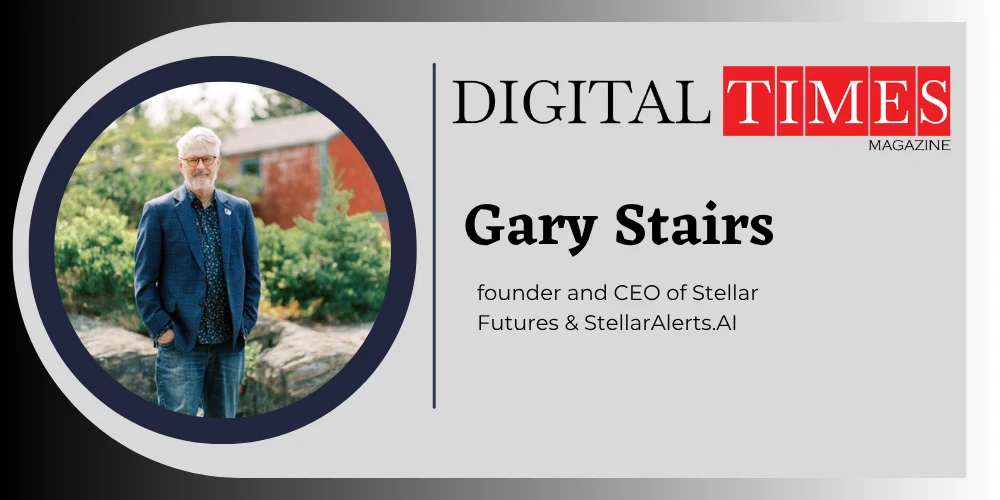
Gary Stairs: Rainmaker, Future Shaper, and Causer of Creative Collisions – founder and CEO of Stellar Futures & StellarAlerts.AI
From a fishing village on the South Shore of Nova Scotia to the boardrooms and stages of international innovation forums, Gary Stairs, CEO of Stellar Futures and StellarAlerts.AI, has built a career on looking at the horizon and moving toward it before most people even notice it’s there. He characterizes himself as a ‘rainmaker, future shaper, and causer of creative collisions’ – labels borne out by decades of work that transformed Atlantic Canada’s role in technology and climate resilience.
“A rainmaker isn’t just about money – it’s about attracting energy, opportunity, and growth.”
Building Atlantic Canada’s Global Identity
Stairs insisted, early on, that New Brunswick and Nova Scotia could matter on the global stage. In the late 1990s and early 2000s, few shared that conviction. The obstacles were immense: entrenched perceptions that Atlantic Canada was too small, too remote, and too traditional to compete in e-learning or technology-driven industries.
Thankfully, New Brunswick’s premier from 1987 to 1997, Hon Frank McKenna, understood that and moved the needle. NBTel, New Brunswick’s telco at the time, also played a key influence through visionary leadership and adoption of technologies, creating what became known as the ‘New Brunswick living lab.’
Stairs was in the vanguard of three Information Highway projects: Tele-Education NB, Enhanced NB911, and NB Alerts (reverse 911). Later he led a trio of change projects at the University of New Brunswick. He also contributed to Fredericton’s drive to be a world-class intelligent community through think tanks, IT conferences, and the mayor’s ‘breakfast club.’ He subsequently served as a board director at ServiceNB, providing governance support to its technological development thrusts.
“The biggest challenge at that time was perception,” he reflects. “Too many thought Atlantic Canada can’t play on the global stage. I knew that was false. We had talent, institutions, and resilience. The real battle was building confidence and connectivity.”
The perceptual challenge was one he helped win, starting in 1992 with Software NB where he brought industry factions together to foster collaboration and create the NB Knowledge Industry News. 4 His foundational work with LearnNB, a province-wide collaborative e-learning association, and 3 later with the National Education Marketing Roundtable (NEMR) in Ottawa, gave Canadian educators and technologists a platform where to speak internationally.
LearnNB and Tele-Education NB proved that provinces could provinces could link K–12 schools, universities, and colleges into one digital system. NEMR amplified Canada’s voice on the global stage, marketing Canadian brainpower collectively rather than in fragmented silos.
He recalls vividly a sales visit to the World Bank headquarters in Washington, where Tele-Education NB’s leadership had, only weeks earlier, impressed the Canada Director at the Bank and the World Bank Institute. “It showed me that even from Fredericton, we could command global attention,” he remembers. “We weren’t small; we showed up early, and that mattered.”
These were also the days of starting a knowledge park on Fredericton’s outskirts and the creation of the e-Novations dark fibre municipal network – a Canadian pioneer that later became a template for digital infrastructure nationwide. These projects made Atlantic Canada a testbed for digital society long before the phrase became fashionable.
Technology with a Social Mission
Stairs has consistently steered technology into service of the public good. He built award-winning ‘eco’ applications to support the New Brunswick Nature Trust, reviewed strategy for Vibrant Communities Saint John, and led successful fundraising campaigns to counter homelessness such as ‘Let’s Get Frank About Homelessness.
The campaign mobilized business leaders, volunteers, and policymakers to acknowledge the scale of housing insecurity through the Fredericton Community Action Group on Homelessness and to address it with innovative partnerships. He also served as a trustee for the O’Brian Humanitarian Trust Foundation, funding scholars’ excellence in post-secondary education.
He is equally proud of his role supporting the foregoing poverty-reduction initiatives that linked economic development with social inclusion. “When you bring technologists, social workers, and business leaders into the same room, real change becomes possible,” he reflects. “That’s collision in action.”
“If you’re in technology and not thinking about the public good, you’re missing the point,” he says.
That same ethos drives StellarAlerts.AI, his flagship initiative. Its goal: to deliver precise, impact-based alerts that protect lives, livelihoods, and infrastructure in the face of extreme weather and climate disruption. As society wrestles with more frequent climate incidents, this mission has become a widely supported imperative. We have entered an era of oceanic ‘boiling’, no longer just warming.
A Global Voice
At his peak, Stairs spoke to more than 21,000 people in a single year, delivering keynotes and workshops on three continents. His message was simple: Atlantic Canada is a laboratory for the future.
“We’re small enough to test bold ideas but big enough to prove global relevance,” he explains.
In 2007, he was formally recognized as a trade ambassador for New Brunswick by the premier of the day and was provided export support by Canada’s department of international trade. These roles gave him platforms to promote Atlantic Canada in Europe, Africa, and North America as a region capable of exporting technology and resilience solutions.
A Foresight Mindset
With a master’s degree in communications and environmental law (Summa Cum Laude) from Simon Fraser University, Stairs has spent decades asking what futures Canada must prepare for. He credits his training as a Science and Technology Policy Foresight practitioner – thanks to the Canadian National Research Council – as having aided Stellar Futures’ capacity for vision.
These foresight projects gave him grounding in futures studies and the ability to anticipate trends, translate complexity into strategy, and guide Stellar with a future-ready mindset. He even helped deliver a futures simulation for the Canadian National Science Advisor, aiding senior policymakers to grasp scenarios of technological disruption and environmental stress.
He also worked with the US NRC’s Board on Science and Technology for International Development (BOSTID) and UPEI’s Institute of Island Studies to bring the World Bank’s Knowledge Assessment Methodology (KAM) to PEI. His instigation of the KAM project was documented by the US National Academies Press in Lighting the Way: Knowledge Assessment in Prince Edward Island, shaping PEI’s policy approach to economic development.
Looking ahead, he identifies several forces: AI in public safety; climate adaptation technologies; digital media exports as an engine for Atlantic Canada; and equity in education.
“Foresight isn’t about predicting the future,” he insists. “It’s about building the capacity to thrive in multiple futures.”
Networks of Influence
Stairs has long straddled boundaries between business, policy, and culture. As a former governor of i-Canada, governing council leader within the Canadian Advanced Technology Alliance, and director emeritus at Goose Lane Editions, he learned how governments, companies, and artists must interact.
“You can’t build technology in a vacuum,” he says. “You need governments to listen, businesses to risk, and artists to remind us why it matters.”
Using Technology to Empower and Protect
Gary sees his greatest achievement not in accolades, but in being of service – leveraging technology to educate, protect, and uplift communities. He believes in ‘Technology with a Purpose.’
Over the years, Stellar RHL and its micro brands have reached more than 600,000 learners in 23 languages worldwide, serving clients from Daimler and Mercedes to UN and national Canadian entities. Projects included Daimler’s global IT security course, supply chain management for UNHCR, restructuring courses for the World Health Organization, and gender equity training for UN Global Peacekeeping.
As well, the company created the SurgeWorld simulation for the Children’s Hospital of LA, the New New Deal game for LA Times readers and the technology for the renowned Congressional Redistricting Game in partnership with the USC Games Development Lab. These projects highlighted how a small Atlantic Canadian company could shape learning and safety practices across global institutions.
Recognition and Responsibility
In 2012, Stairs was honored with the Queen Elizabeth II Diamond Jubilee Medal for contributions to Canada’s IT sector. He describes it as both humbling and energizing.
Today, Stellar Futures has re-emerged with a sharpened focus on the green economy and climate adaptation. The idea is to reframe resilience spending as investment rather than cost.
StellarAlerts.AI now creates digital twins of vulnerable communities, allowing policymakers and emergency managers to visualize outcomes and rehearse interventions before disaster strikes. These digital environments replicate infrastructure, topography, and even human behavioral responses, enabling municipalities and insurers to quantify risk and build resilience ROI models.
Strategic partners include AWS Canada, NSCC’s Centre of Geographic Sciences, and Stage² at the UNB Advanced Computing Innovation Centre. Stellar is also in Propel ICT’s acc accelerator, Traction and Growth, giving them access to top coaches and curriculum, further sharpening their growth path.
“Every mentor session at Propel taught us something new,” he recalls. “One coach showed us how to turn municipal budgeting constraints into business opportunities. Another drilled us on storytelling to investors. That mix of tough love and encouragement has been invaluable.”
He also stresses the broader economic stakes of this work. “If Atlantic Canada is to thrive, we must see climate adaptation not as a defensive posture but as an export opportunity. The same digital twins we’re building for coastal villages here can serve island nations, U.S. states, or European ports. Resilience can be our brand.”
This belief is already shaping conversations with credit unions and insurers. By showing that dollars invested in resilience generate measurable returns, Stellar is reframing adaptation from an expense into an asset class. “It’s a financial innovation story as much as a technology story,” Stairs explains. “And if we can make that case from Atlantic Canada, we can help the world see resilience in a new light.”
He argues that Atlantic Canada’s geography gives it credibility. “We live with storms, floods, and coastal erosion every year. If our solutions work here, they will work anywhere. That’s our export advantage.”
Guidance for the Next Generation
When asked what advice he has for young entrepreneurs, Stairs doesn’t hesitate:
“Don’t chase unicorns. Build tools that matter. Focus on solving real problems in your community. Scale and recognition will follow. And most importantly – find your collisions. Surround yourself with people who don’t think like you.”
He encourages them to travel but always return with insights for their home region. “The future of Atlantic Canada depends on a generation that can see the world, bring back what works, and apply it here with courage.”
The Person Behind the Entrepreneur
Though often relentless, Stairs shares glimpses of the personal rhythms that keep him grounded. His three favourite books are: *The Knowledge-Value Revolution* (Sakaiya), *Inventing the Future* (Brand), and *The Innovator’s Dilemma* (Christensen). He is a former lifeguard and varsity swimmer.
Living today in Blue Rocks, Nova Scotia, he finds the coastal landscape grounding and inspiring. “The sea reminds me daily of resilience and beauty,” he notes. “Moderate temperatures, quiet nights and starlit skies. A real regret here is relinquishing my border collie, Ace, to an Ontario sheep farm where he now thrives and fulfills his calling.”
He also delights in the creative life shared with his wife, Gayle Grin, a globally recognized designer. Their morning ritual of coffee by the sea often turns into a mix of news-sharing, communion and waking-up in the broadest sense.
If given the chance to share dinner with three figures, he would choose the Hon. Frank McKenna, PC; Hon. Milton F. Gregg, VC; and Zita Cobb. McKenna recently congratulated Stellar on its ‘Digital Triplet’ prototype for forecasting and warning services.
Gregg, remembered as one of New Brunswick’s most decorated military figures, was Gary’s childhood neighbor and mentor in Sussex. Cobb, founder of the Fogo Island Inn, remains a rural economic development icon he admires. “Imagine that dinner table,” he smiles. “Politics, war, technology, business and faith.“
He also cheers on his son’s entrepreneurial venture in New Brunswick. “Watching the next generation step forward is both humbling and thrilling. It reminds me why we do this.”
A Legacy of Futures Built at the Edge
11 The story of Gary Stairs is not just about entrepreneurship. It is about building futures from the edge – whether geographic, technological, or cultural. From tele-education in New Brunswick to AI-driven alerting in Atlantic Canada, his career has redefined what is possible for a region often underestimated.
And as he looks ahead, the rainmaker, future shaper, and causer of creative collisions shows no signs of slowing down.
He reflects often on legacy. “For me, it’s not about titles or exits,” he says. “It’s about whether the systems we’ve built keep serving people after we’re gone. If an elderly, or even a younger, person in 2040 is safer during a storm because of a decision we made today, then we’ve done our job.”