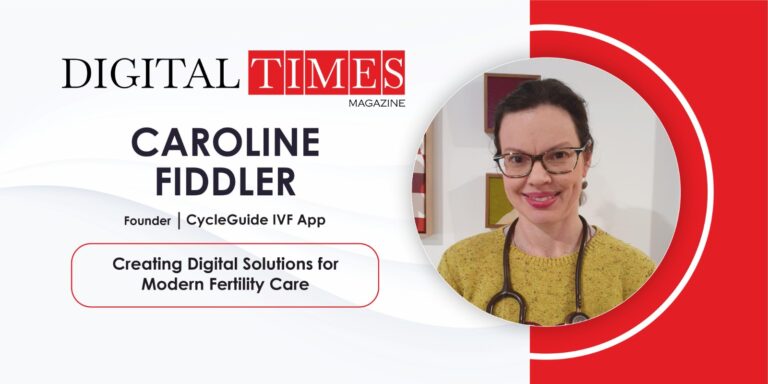
Caroline Fiddler: Creating Digital Solutions for Modern Fertility Care
Fertility treatment has a peculiar way of shrinking life into a series of dates, alarms, and waiting periods. A single cycle can revolve around blood tests before sunrise, medications timed down to the minute, unexpected phone calls from nurses, and calendar entries that suddenly determine the course of months, or even years. For many patients, the experience unfolds not in the consultation room but at home, in the workplace, in supermarket aisles, and in parked cars where important calls are answered between meetings. It is a deeply personal journey, yet one that often depends on systems and processes that have changed surprisingly little over time.
Caroline Fiddler knows this reality from both sides. As a doctor, she understood the science behind fertility treatment. As an IVF patient, she experienced the uncertainty, mental load, and constant responsibility that come with managing a cycle. What stood out most was not the complexity of the medicine itself, but the simplicity of the tools used to communicate it. Vital instructions were still being delivered through paper schedules and hurried phone conversations, leaving patients to piece together one of the most important journeys of their lives. Rather than accepting that as part of the process, Caroline began asking a simple question: surely there has to be a better way. That question would eventually become CycleGuide, a platform designed to bring clarity, organization, and confidence to fertility treatment while giving patients something they often feel they are losing: the sense of being in control.
A Doctor’s Mission to Reimagine Fertility Care
Caroline’s journey into the fertility technology space was shaped by both her medical career and her personal experience as an IVF patient. Drawn to medicine from an early interest in science, she built a diverse career across multiple healthcare settings and specialties throughout Australia. While she found patient care deeply rewarding, she was often frustrated by the inefficiencies and rigid structures within traditional healthcare systems.
Her perspective changed dramatically when she underwent IVF treatment herself. Experiencing the process as a patient revealed significant communication gaps between clinics and patients, particularly regarding the delivery of complex and time-sensitive treatment instructions. Caroline recognized that despite advances in reproductive medicine, many clinics still relied on photocopied forms and verbal instructions that left patients vulnerable to confusion and anxiety.
Unable to ignore what she saw as an obvious problem, she decided to create a solution. What began as a personal observation evolved into a mission to modernize fertility treatment communication and give patients greater control over their care.
Identifying a Critical Gap in IVF Care
The motivation behind CycleGuide stemmed directly from Caroline’s own IVF experiences. Throughout multiple treatment cycles across different clinics, she repeatedly encountered communication systems that felt outdated and inefficient.
Treatment instructions, which dictate medications, tests, and appointments over several weeks, were typically provided through paper-based schedules and supplemented by verbal updates from nurses. Caroline found these methods difficult to manage, especially as instructions often changed based on ongoing test results.
She observed that paper schedules were inflexible, difficult to update, and prone to errors. Patients frequently had to write down critical information during phone calls, creating unnecessary stress and increasing the risk of misunderstandings. The recurring nature of these challenges convinced Caroline that the issue was systemic rather than isolated to a single clinic.
CycleGuide was created to address these shortcomings by providing a more organized, accessible, and reliable way for patients to manage fertility treatment.
Putting Patients at the Center of the IVF Journey
Caroline designed CycleGuide with one primary objective: reducing the logistical and emotional burden of fertility treatment.
Drawing from her own experiences, she created a purpose-built application that simplifies the management of IVF cycles through intuitive design and clear organization. The platform centers around a monthly calendar view that allows patients to visualize their entire treatment journey while focusing on daily responsibilities.
The app incorporates color-coded categories for medications, blood tests, ultrasounds, procedures, appointments, and cycle milestones. Tasks can be easily updated as treatment plans evolve, ensuring patients always have access to the latest instructions.
One of the app’s defining features is its notification system, which provides reminders for time-sensitive medications and appointments. By transforming static paper instructions into an interactive digital experience, Caroline sought to make treatment management more accurate, convenient, and patient-friendly.
She also introduced a pre-cycle checklist designed to help patients prepare for treatment before their cycle begins. This feature addresses practical concerns such as medication storage, injection preparation, and identifying key treatment milestones, helping patients feel more informed and confident before treatment starts.
Transforming an Idea into Reality
Building CycleGuide was far from straightforward. One of Caroline’s greatest challenges was maintaining the simplicity of the platform despite constant suggestions to expand its functionality.
Throughout development, she remained focused on solving a specific problem rather than creating an overly complex application. Guided by the principle that users value simplicity and reliability over unnecessary features, she resisted adding functions that could distract from the app’s core purpose.
Another significant challenge involved convincing fertility clinics that existing communication methods required improvement. Caroline discovered that many decision-makers within clinics had limited visibility into the patient experience and were often unaware of the frustrations caused by traditional treatment instructions.
Financially, the journey demanded considerable personal investment. Caroline used her savings, refinanced her home loan, and received support from family members to fund development. At the same time, she balanced the uncertainties of entrepreneurship with the responsibilities of a medical career and family life.
These experiences strengthened her leadership philosophy, teaching her the importance of conviction, adaptability, and persistence when pursuing meaningful change.
Harnessing Digital Technology to Improve Understanding
Caroline views technology as a practical tool for empowering patients rather than replacing human care.
CycleGuide leverages the familiarity and accessibility of smartphones to bring fertility treatment management into a digital environment where patients already organize much of their daily lives. By allowing users to input, review, and interact with their treatment plans, the platform encourages greater engagement with the treatment process.
She found that entering instructions directly into the app reinforced her understanding of treatment requirements and increased her confidence in following them accurately. This improved organization also freed mental space to focus on more significant decisions surrounding treatment, such as selecting fertility specialists, evaluating treatment strategies, and understanding embryo development.
Rather than overwhelming patients with excessive information, Caroline designed the platform to provide clarity and structure, helping users navigate a complex medical journey with greater confidence.
The Voices Behind CycleGuide’s Evolution
Feedback from IVF patients has played a crucial role in shaping CycleGuide’s development.
Through conversations with individuals undergoing fertility treatment, Caroline gained deeper insight into the emotional and practical challenges patients face. Some described feeling as though they were trapped in a repetitive cycle with little control over the process. Others expressed anxiety about medication administration, treatment instructions, and navigating communication with clinics.
Many patients highlighted frustrations with traditional communication methods, including repeated identity verification procedures during phone calls and the difficulty of receiving important updates while at work or traveling.
These experiences reinforced Caroline’s belief that while many aspects of fertility treatment are beyond a patient’s control, the management of treatment instructions is not. By simplifying this component of the journey, she aims to reduce anxiety and allow patients to focus their energy on informed decision-making, emotional wellbeing, and the broader aspects of their lives.
A Mission Rooted in Empowerment
For Caroline, CycleGuide is more than a digital tool—it is an effort to give patients greater ownership of their fertility journey. Combining her medical expertise with lived experience, she has developed a platform that addresses a practical challenge often overlooked within fertility care.
Her work reflects a broader belief that healthcare innovation does not always require revolutionary technology. Sometimes, meaningful progress comes from identifying everyday frustrations, listening closely to patients, and creating solutions that make complex experiences simpler, clearer, and more manageable.
Innovation Guided by Simplicity and Trust
Caroline believes that innovation in digital health must be balanced with careful planning, responsible design, and a strong commitment to patient trust. Throughout the development of CycleGuide, she deliberately avoided unnecessary features that could complicate the user experience or create privacy and legal concerns.
Rather than incorporating messaging functions between patients and clinic staff, she prioritized communication methods that she felt were clearer and safer. Caroline also chose not to provide clinical advice within the platform, preferring to leave medical guidance to patients’ treating teams. Instead, CycleGuide focuses exclusively on organizing treatment instructions and helping patients manage their fertility journey more effectively.
Her philosophy has always been to keep the platform lean, purposeful, and focused on solving a specific problem. By limiting the amount of personal information collected and avoiding features that would require extensive data storage, she sought to reduce privacy risks while maintaining the app’s effectiveness.
To ensure compliance and security, Caroline collaborated with app development specialists and legal professionals in multiple jurisdictions. Treatment information within the standalone version is stored locally on the user’s device and can be removed at any time, while the clinic-integrated version incorporates processes designed to protect patient confidentiality and data security.
A Different Approach to Fertility Technology
When researching fertility applications during the development phase, Caroline found that many existing solutions attempted to do too much at once. She observed that many platforms were crowded with features, inflexible in design, or focused on functions that did not address what she considered the most stressful aspect of fertility treatment: managing treatment instructions.
This insight reinforced her commitment to creating a simple, intuitive platform centered solely on treatment management. CycleGuide was designed with a clean visual aesthetic, flexible functionality, and a structure that accommodates different fertility pathways rather than forcing users into predefined treatment journeys.
Unlike many alternatives, the platform provides a full monthly calendar view, enabling patients to see their entire treatment cycle in context. Caroline believed this broader perspective would help users plan more effectively and better understand how treatment fits within their daily lives.
She also deliberately avoided overly emotional design elements, preferring a neutral and professional approach that respects the seriousness of fertility treatment. Every design decision was guided by her belief that technology should reduce stress rather than add another layer of complexity.
Keeping the Focus on What Matters Most
Throughout development, Caroline consistently returned to a simple principle: applications should perform their core function exceptionally well.
She questioned the value of features such as embryo time-lapse viewing, integrated payment systems, and extensive educational content within fertility apps. In her view, many of these functions already existed elsewhere or risked creating confusion if they duplicated information provided by clinical teams.
Instead, she concentrated on developing a platform that addresses a critical and often overlooked challenge, helping patients accurately follow treatment instructions while managing the realities of daily life.
Her own experiences showed that fertility patients spend much of their treatment journey outside the clinic, making organization, timing, and clarity essential components of success. By focusing exclusively on these needs, she aimed to create a tool that genuinely improves the patient experience rather than simply adding another digital platform to navigate.
Technology’s Role in the Future of Fertility Care
Looking ahead, Caroline believes emerging technologies such as artificial intelligence will play an increasingly important role in fertility treatment. She anticipates that AI could streamline tasks such as ultrasound assessments and follicle measurements, improving efficiency for both clinicians and patients.
However, she feels that technological advancement alone is not enough. Equally important is creating a more patient-centered fertility experience.
Caroline hopes to see clinics place greater emphasis on emotional sensitivity, recognizing the complex realities faced by individuals undergoing fertility treatment. She also advocates for broader efforts to improve affordability and accessibility, noting that treatment costs remain a significant barrier for many aspiring parents.
Drawing from her own ongoing fertility journey, she is particularly passionate about reducing regulatory and logistical obstacles that can complicate treatment pathways. For her, the future of fertility care should combine innovation with empathy, ensuring that patients feel supported throughout every stage of their experience.
Building a Global Platform for Fertility Patients
Caroline’s long-term vision for CycleGuide extends far beyond its current footprint. She envisions the platform being available globally as both a standalone application and a fully integrated clinic solution, adapted to different languages and healthcare environments.
A key part of this vision involves allowing fertility clinics to incorporate their own branding and seamlessly integrate CycleGuide into existing workflows. Through deeper software integration, treatment instructions could be delivered directly to patients’ smartphones in real time, providing immediate written confirmation of verbal guidance from nursing staff.
She believes this approach could significantly improve communication, reduce administrative burdens, and increase patient confidence throughout treatment.
Ultimately, Caroline hopes CycleGuide will help modernize some of the most routine yet impactful aspects of fertility care. While much attention is often given to scientific breakthroughs and advanced reproductive technologies, she believes there is equally important work to be done in improving everyday processes that affect patients and clinic staff alike.
For Caroline, success means creating a healthcare environment where fertility patients feel more informed, organized, and supported, allowing them to focus less on managing instructions and more on navigating one of the most important journeys of their lives.
Lessons from a Book That Resonated Deeply
One book that has had a profound influence on Caroline’s thinking is The Patient Doctor by Dr. Ben Bravery. The book tells the story of a scientist who, after being diagnosed with bowel cancer at a young age, retrained as a doctor and later reflected on the realities of modern healthcare from both sides of the patient-doctor relationship.
Caroline found particular value in the book’s candid examination of hospital systems and the resistance to seemingly simple changes that could improve patient experiences. Many of the frustrations described by Dr. Bravery mirrored her own observations throughout her medical career, especially regarding inefficiencies and barriers to innovation within healthcare settings.
His willingness to challenge established practices and advocate for patient-centered improvements reinforced Caroline’s own determination to pursue meaningful change through CycleGuide. The book validated many of her experiences and strengthened her belief that even small improvements in healthcare processes can have a significant impact on patients’ lives.
Finding Balance Through Movement and Family
Outside of her professional work, Caroline enjoys simple activities that allow her to stay active while spending time with loved ones. Walking is one of her favorite forms of exercise, whether through local neighborhoods or along tracks surrounded by Australia’s native bushland.
She also enjoys outdoor activities with her daughter, Alice, including playing ball games, gardening, and going for walks together. These moments provide both physical activity and valuable opportunities to connect as a family, helping her maintain balance amid the demands of entrepreneurship and medicine.
The Everyday Moments That Recharge Her
When taking time away from work, Caroline finds relaxation in spending quality time with her family. Coffee and conversation with her parents and brother are among the simple pleasures she values most, while time spent laughing and playing with her young daughter remains a constant source of joy.
Reading is another important outlet. She is particularly drawn to books written by healthcare professionals who have experienced the healthcare system as patients themselves. Titles such as The Patient Doctor by Dr. Ben Bravery and You Called an Ambulance for What? by Tim Booth have provided both insight and reflection.
Caroline also enjoys visiting art galleries, particularly those showcasing local and accessible artwork. Travel offers another opportunity to recharge, especially day trips through rural Victoria and visits to Perth, a city that holds special significance because of her family connections. Some of her favorite destinations include the cafés of Subiaco, the vibrant atmosphere of Fremantle Markets, the coastline of Cottesloe Beach, and the natural beauty of Rottnest Island.
Admiring Innovators Who Solve Real Problems
Among the innovators Caroline most admires are Nakita Dsouza and Nikhil John, the founders of IVF Computer, a purpose-built electronic medical record platform designed specifically for fertility clinics.
What resonates most with her is that their innovation emerged from personal experience. Having undergone IVF treatment themselves, they gained firsthand insight into the operational inefficiencies that exist within fertility care and used that knowledge to develop a practical solution.
Caroline appreciates their commitment to creating technology that directly addresses the needs of fertility clinics and patients. She is particularly impressed by their collaborative approach, working closely with clinics to refine and improve the platform based on real-world feedback. For her, their journey exemplifies how personal experience, combined with professional expertise, can drive meaningful innovation in healthcare.
The Courage to Pursue an Idea
For aspiring entrepreneurs seeking to create meaningful change in healthcare or technology, Caroline’s advice is straightforward: have a go.
Looking back, she admits that if she had fully understood the challenges involved in developing, funding, and promoting an app, she might never have started. Yet she is grateful that she pursued the idea despite the uncertainty, guided by a simple conviction that there had to be a better way to manage fertility treatment instructions.
Throughout the journey, she experienced moments of doubt, financial pressure, and frustration. However, she ultimately concluded that taking the risk was far preferable to spending years wondering whether she could have turned her idea into reality.
Caroline also encourages entrepreneurs to remain true to their original vision. While feedback and suggestions can be valuable, she believes it is important not to lose sight of the core problem being solved. In her experience, people often propose additional features or alternative directions, but not every suggestion is essential to the success of a product.
Her advice is to listen carefully, evaluate ideas objectively, and continually ask whether a suggested change is truly critical. By staying focused on the original purpose and resisting unnecessary complexity, entrepreneurs can build solutions that remain authentic to the problem they set out to solve.
Read All recent Features: Magazines