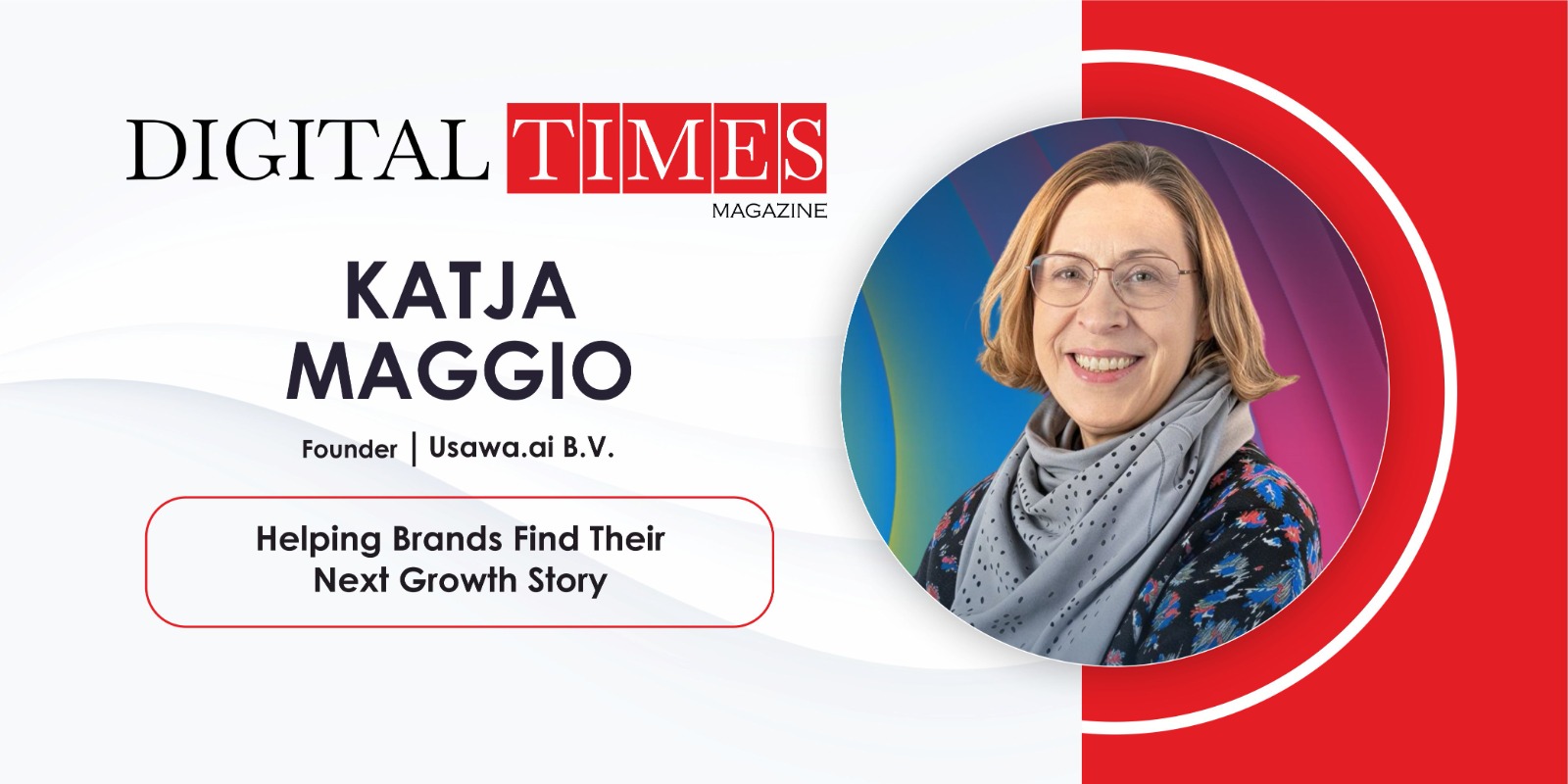
Katja Maggio: Helping Brands Find Their Next Growth Story
Katja Maggio’s career has taken her across global brands and diverse categories, from Fabric Care and Hair Care to Beverages, Home Care, Beauty, and more recently Pet Care. Across these different markets, she observed a recurring challenge: organizations often had access to more data, tools, and information than ever before, yet struggled to translate them into greater clarity, stronger relevance, and lasting customer value.
This insight became central to the creation of Usawa.ai. As its Founder, Katja brings together human understanding, cultural intelligence, artificial intelligence, and strategic thinking to help organizations identify emerging growth spaces, renew brands, and build stronger connections with changing consumer needs. Her approach is grounded in the belief that meaningful transformation does not come from technology alone, but from combining its capabilities with a deeper understanding of people, culture, and the forces shaping behavior.
We spoke with Katja about her professional journey, the vision behind Usawa.ai, and the evolving relationship between AI, human insight and business transformation.
Below are the highlights from the interview.
Please tell us about your professional journey and what inspired you to establish Usawa.ai.
My professional journey has taken me across Fabric Care, Hair Care, Beverages, Home Care Beauty; categories with very different consumer dynamics, but often similar tensions. Again and again, I saw teams under pressure chasing short-term tactics in the belief that these would eventually take care of brand health and growth. In reality, I often observed the opposite: brand entropy increasing in environments that were rich in data but poor in clarity. The more data organizations accumulated, the more fragmented decisions sometimes became, and the weaker the link to real value creation. Usawa.ai was born from that observation: to help leaders reconnect data, human understanding, and strategic focus in ways that renew brands and unlock more durable growth.
As a strategic leader with extensive experience in transformation and brand reinvention, what have been the most defining moments of your career?
Several moments have been especially formative. Early in my career at PG, I was responsible for smaller brands with very limited budgets. That constraint sharpened my creativity and taught me to build deeper customer understanding in more unconventional ways, rather than relying on standard playbooks or spend. A few years later, working on anticipatory learning and future scenarios showed me how deeply assumptions shape strategy, how difficult it can be for businesses to anticipate change when those assumptions no longer fully reflect the market, and how valuable unconventional thinking is in widening the field of vision. Leading global brand work added another important layer: it taught me to look beneath surface similarities, read culture more carefully, and understand how local nuances shape relevance and growth. Then came the turnaround situations, businesses under real pressure that needed reinvention, not incremental adjustment. Those experiences taught me the importance of addressing the hard structural issues rather than reaching for easy tactical patches, and the power of disruptive, challenger thinking to refresh tired brands and create new growth spaces.
Usawa.ai operates at the intersection of AI, data, analytics, and human-eccentric innovation. What vision drives the company, and how do you differentiate it in the market?
Usawa.ai is driven by the belief that the brands that win tomorrow will not simply move faster; they will move differently. In a world saturated with data, cluttered content, and imitation, advantage comes from building meaningful difference: seeing earlier where culture, behavior, and demand are shifting, and translating that into brand propositions that people find more relevant, more distinctive, and more valuable.
That is where Usawa.ai is different. We combine cultural foresight, human-eccentric insight, big data analytics, and AI to help organizations shape new growth spaces rather than follow them. Usawa.ai operates both as a strategic partner and as an incubator — helping brands tune into signals that matter, turn insights into Maps with agility, and build new challenger positions that others find hard to follow.
You are known for combining deep human insights with data analytics. How do you strike the right balance between technology and human-centricity in business decision-making?
I see technology as something that broadens the line of sight, not something that replaces human judgment. AI and analytics are extraordinarily powerful in helping brands detect patterns earlier, connect fragmented signals, learn faster, reduce noise, and uncover blind spots. But reading people as people, rather than simply as data points, remains essential. Human understanding and cultural intelligence are invaluable in interpreting meaning, reading context, resolving frictions, and navigating the trade-offs that strategy requires. That is where balance lies. For me, the opportunity lies in using data and technology not to automate thinking or distance brands from people, but to deepen human understanding and help brands make more meaningful choices.
What are some of the biggest challenges organizations face when undergoing digital transformation, and how can they overcome them successfully?
The biggest challenges in digital transformation are rarely technological. They are structural and human.
Many organizations treat digital transformation as a technology rollout rather than a redesign of how value is created, decisions are made, and customers are served. This often leads to more tools, more dashboards, and more data, but also greater fragmentation, slower decision-making, short-term focus, and weaker accountability.
Too often, digital transformation is positioned as the answer to brand renewal or modernisation. Yet technology alone is rarely enough to address declining relevance or a weakening emotional connection with customers.
In my experience, successful teams clearly identify the underlying business gaps, remain anchored in customer value, and are willing to address structural issues, the ways of working, ownership models, incentives, and assumptions that no longer reflect the market. Technology can accelerate transformation, but it cannot, on its own, rebuild relevance, strengthen emotional connection, or create the strategic distinctiveness a brand has yet to define.
How do you see AI, data analytics, and customer engagement evolving over the next five years, and what opportunities should businesses prepare for today?
Over the next five years, AI will make it much easier to automate content, generate creatives, and personalise at scale. But that same acceleration will also increase clutter, weaken distinctiveness, and, in many cases, erode trust. As more of the market becomes synthetic, the premium will shift to what feels genuinely human, meaningfully different, easier to choose and easier to trust. In my view, competitive advantage will increasingly come from balancing the speed and power of AI with real human and emotional connection. The winners will not be those who automate the most, but those who use technology to make brands more useful, more human-eccentric, and more trusted. That belief is central to the way we work at Usawa.ai.
Your expertise includes business model reinvention and uncovering emerging customer needs. What trends are currently reshaping consumer behavior and brand engagement?
Several shifts are reshaping behavior and brand engagement today. The first is clutter fatigue: consumers are surrounded by more content, more claims, and more choice, which makes attention harder to earn, trust easier to lose. The second is that function alone no longer differentiates. Increasingly, people choose brands not only for what they do, but for what they express, how they make them feel, and whether they fit naturally into their lives. The third is fragmentation, of channels, influence, demand, and identity, which means old mass-market playbooks are becoming less effective. In that environment, the brands that win are those that create meaningful difference, reduce friction, and foster a stronger sense of connection and wellbeing. They do not simply go faster to keep up; they play differently to create new growth spaces before the category is forced to reset.
Can you share a success story or transformation initiative that had a significant impact on business growth and customer value creation?
One transformation that best captures my approach was the turnaround of Downy/Lenor, a flagship fabric care brand. In 2003, the brand had been stagnating for years and had reached a real point of breakdown across Europe. The business did not need more short-term fixes; it needed a new growth logic. We went back to the customer to understand not only functional needs, but the deeper cultural and emotional disconnects that had weakened the brand’s relevance. That work opened new growth spaces, inspired more disruptive innovation, and helped the team move from defensive thinking to a much clearer and more ambitious path forward. As a result, the European team managed to turn around the brand and identify a stronger and more sustainable source of customer value.
What leadership principles have helped you drive sustainable growth and inspire high-performing teams throughout your career?
A few principles have guided me consistently. First, stay deeply anchored in people as people. Value creation starts with understanding human needs, triggers, frictions, and the cultural context shaping behavior. Second, face reality early and without defensiveness. Sustainable growth starts when teams are honest about what is no longer working. Third, have the courage to address the hard structural issues rather than reaching for easy tactical patches. Fourth, create clarity. In periods of change, people do not need more noise; they need focus, direction, and a shared sense of what matters most. And finally, build momentum through meaningful early wins while creating a safe environment for people to learn, adapt, and move forward with confidence.
What advice would you give to future leaders, entrepreneurs, and professionals who aspire to drive meaningful change through innovation and technology?
My advice would be: stay curious and keep learning. Learn to connect the dots and build depth where it matters. Stay grounded in people, culture, and what customers are really trying to solve in their lives. Learn to question assumptions; the map is not the territory. Many businesses struggle not because they lack information, but because they hold on to yesterday’s logic for too long. And finally, do not wait for certainty. Face ambiguity and move forward with courage, humility, and balance.
Personal Insights
What are some of your favorite books, and how have they influenced your leadership philosophy?
I do not really switch off with business books. In my free time, I am more likely to reach for a novel such as
The Lions of Sicily, Fresh Water for Flowers, or The Letter Carrier: a novel. I enjoy stories that stay with you because they reveal something true about people, relationships, and empathy.
For professional learning, I’m drawn to more interactive formats, such as real business cases, hands-on learning, and discussion with fellow students. I recently completed two HBS Certificates of Specialization, one in Strategy and one in Entrepreneurship & Innovation. I especially enjoyed learning about disruptive innovation and winning with digital platforms. I also found the MIT Sloan + CSAIL Artificial Intelligence: Implications for Business Strategy Program, very informative. That combination, staying connected to people through stories, while continuing to learn through structured and practical formats, continues to shape my leadership in a very real way.
Are there any authors, thought leaders, or industry experts whose work has significantly shaped your thinking?
A few thinkers have shaped my perspective in different ways. Professor Clayton Christensen had a deep influence on how I think about disruption, the importance of understanding Jobs to Be Done, hidden vulnerability, and seeing change before it becomes obvious. The work of Professor Byron Sharp and Professor Jenni Romaniuk at the Ehrenberg-Bass Institute has been important in bringing rigor to how brands grow, particularly around Category Entry Points, Distinctive Assets, and the importance of building both physical and mental availability. In semiotics, Malcolm Evans, Fiona McNae, and Malex Salamanques have helped sharpen how I think about meaning, cultural codes, and the forces shaping brands beyond what consumers explicitly say. Together, their work has shaped my belief that strong strategy comes from combining rigor, curiosity, and a deeper reading of people and culture. I have also been fortunate to learn from outstanding leaders and insight practitioners over the years, whose example reinforced the importance of going deeper, staying curious, and holding strategy to a high standard.
Do you actively participate in any sports or fitness activities? If so, what do they teach you about leadership and resilience?
Yes, I exercise daily, but the form it takes depends on what I need most in that moment. Some days it is yoga or meditation, other days dancing or weight training. Each brings something different, and together they help me find balance. More than anything, I see them as part of conscious energy management. They help me reset, stay grounded, and maintain the clarity and stamina that leadership requires over time.
Outside of work, what hobbies or interests help you recharge and maintain creativity?
Outside work, I recharge through family, reading and learning, music, and gardening. Family keeps me grounded; reading and learning feed my curiosity and help me stay connected to people and the world. Music helps me connect with my emotions, and gardening reconnects me with nature. One of the moments I value most each year is making olive oil with my brothers. It is hard work, simple, real, and deeply grounding, a true reset and, in many ways, food for the soul.
Looking ahead, what personal or professional goals are you most excited about pursuing in the coming years?
Looking ahead, I am excited about contributing to real value creation in a way that is both meaningful and grounded in delighting customers. I also want to continue building Usawa.ai thoughtfully, creating an environment that attracts talented people, gives them room to grow, and opens up real opportunities and jobs. Beyond that, I would like to give back to the community and build something that is not only commercially successful, but also human, generous, and enriching. For me, that is the kind of growth worth pursuing.
Read More:Will Shu: The Entrepreneur Transforming Food Delivery Through Deliveroo