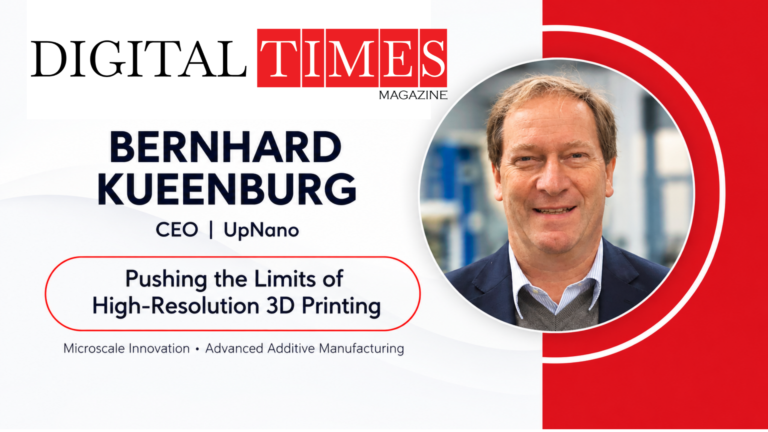
Bernhard Kueenburg: Pushing the Limits of High-Resolution 3D Printing
The history of innovation is often told through products that changed the world.
The smartphone. The microchip. The internet.
What receives far less attention are the technologies that made those breakthroughs possible in the first place.
Behind every leap forward is a layer of innovation that rarely makes headlines but quietly expands the limits of what can be achieved. Today, one of those frontiers exists at the microscopic level, where engineers and scientists are creating structures so small they can barely be seen, yet powerful enough to influence industries worth billions.
It is in this world that UpNano has built its reputation, under the leadership of CEO Bernhard Kueenburg.
The company has become one of the most innovative names in high-resolution 3D printing, helping researchers and manufacturers turn ambitious concepts into tangible reality. From healthcare and biotechnology to photonics and fusion energy, its technology is enabling applications that were unimaginable just a few years ago.
Blueprint for Industrial-Scale Innovation
For Bernhard, UpNano’s rapid rise in the high-resolution 3D printing industry is rooted in a combination of visionary technology, strategic focus, and exceptional talent. He credits the company’s success to the people behind it, particularly co-founder and CTO Peter Gruber, whose groundbreaking work led to the development of the NanoOne, a high-resolution 3D printer that was 100 times faster than industry standards when it launched. Equally important was COO Denise Hirner’s ability to establish the company in the market at an impressive pace. Together with a growing team of highly skilled professionals, Bernhard has remained focused on a clear objective from the outset: building the fastest high-resolution 3D printing technology for industrial scale-up and commercial production.
Leading Through Trust and Human Connection
Throughout his career, Bernhard’s leadership philosophy has remained remarkably consistent. He believes in trusting the people he chooses to work with, recognizing the individual behind every role, and creating an environment where employees can grow both personally and professionally. He views leadership as a responsibility to set an example through strong work ethics, commitment, and enthusiasm. For him, successful organizations are built on mutual respect, trust, and opportunities for continuous development.
The Formula Behind High-Performing Teams
While technical expertise is a critical starting point when building teams, Bernhard believes that personality and cultural diversity are equally important. He has focused on creating an environment that brings together individuals with different backgrounds, perspectives, and experiences. This balance has enabled UpNano to cultivate a team filled with brilliant technical minds while maintaining a collaborative and innovative culture that drives performance.
Redefining the Limits of 3D Printing
At the heart of UpNano’s technological breakthrough is two-photon polymerization, a process that uses a femtosecond laser to harden liquid resin and create highly detailed three-dimensional structures. Traditionally known for its precision but limited by slow production speeds, the technology was transformed through innovations developed and patented by Peter Gruber. Bernhard highlights that these advancements have enabled UpNano to achieve unprecedented printing speeds while maintaining sub-micron precision, positioning the company as a leader in high-performance additive manufacturing.
Transforming Industries Through Microfabrication
Bernhard sees enormous potential for UpNano’s technology across several sectors that are poised to shape the future. In healthcare, the company’s solutions are enabling the production of microfluidic devices for applications such as in vitro fertilization and advanced micro-endoscopes. In the rapidly growing nuclear fusion industry, UpNano’s technology can manufacture the highly complex micro-targets required for fusion reactors. The photonics sector also represents a major opportunity, with the company’s ability to print microlenses directly onto photonic chips helping improve speed, efficiency, and energy consumption in next-generation data centers.
From Academic Research to Global Commercial Success
Transitioning from a university spin-off to an internationally recognized company presented unique challenges. Bernhard explains that the company initially operated with a strong academic mindset, which had to evolve as the organization expanded. The key challenge was introducing structures and processes that supported scalability and efficiency without sacrificing agility. Maintaining that balance remains an ongoing priority as UpNano continues to grow.
Unlocking the Future of Bioprinting
Although industrial bioprinting has not yet become UpNano’s largest market segment, Bernhard remains optimistic about its long-term potential. Many academic researchers already use the company’s bioprinting capabilities to create three-dimensional cellular environments that improve drug screening and reduce reliance on animal testing. He believes the technology will also play a critical role in tissue regeneration and the development of advanced cellular scaffolds for future medical applications.
The Power of Collaboration in Innovation
Drawing on his experience across pharmaceuticals, biotechnology, and medical technology, Bernhard emphasizes that meaningful innovation rarely happens in isolation. He believes collaboration between companies, research institutions, suppliers, and industry partners is essential for accelerating progress. UpNano actively participates in research consortia and strategic partnerships that provide access to expertise and capabilities beyond what any single organization could achieve independently. These collaborations have become a cornerstone of the company’s innovation strategy.
Preparing for the Next Manufacturing Revolution
As artificial intelligence and automation continue to transform industries, Bernhard views UpNano’s technology itself as a key component of next-generation manufacturing. While AI currently supports the company’s business processes rather than its core printing technology, he remains open to future applications. He anticipates that customers will increasingly use AI-driven design optimization tools, which can then be brought to life through UpNano’s advanced manufacturing systems, creating powerful synergies between digital intelligence and precision production.
Balancing Innovation with Commercial Reality
For Bernhard, technological innovation only matters if it solves real-world problems. Risk management at UpNano involves continuous evaluation through business and technical assessment frameworks, as well as close engagement with customers. The company has established an annual scientific user event that serves as a platform for gathering feedback, understanding evolving needs, and strengthening its global user community. This customer-centric approach allows UpNano to prioritize innovations that deliver meaningful value while minimizing unnecessary risk.
Building Success Through Relationships and Trust
Relationships have played a pivotal role throughout Bernhard’s professional journey. Strong networks have helped the company attract talent, secure suppliers, build customer relationships, and gain investor confidence. He views customers and suppliers not simply as business contacts but as long-term partners. Trust, collaboration, and shared goals have consistently contributed to successful outcomes, while mentorship remains an important tool for developing future leaders within the organization.
A Vision for Industry Leadership
Looking ahead, Bernhard’s vision for UpNano is centered on continuously enhancing the speed, performance, and industrial scalability of its technology. He wants the company to empower manufacturers across multiple industries to produce micro-scale components that were previously impossible to create. Beyond technological advancement, he aspires to establish UpNano as a leading industrial partner on the global stage. With ambition, persistence, and a measure of good fortune, Bernhard hopes the company will continue its growth trajectory and ultimately become one of Austria’s most successful technology enterprises.
The Books That Shaped a Leadership Philosophy
Two books have had a particularly profound influence on Bernhard’s leadership style and entrepreneurial mindset. The first is Myth Motivation by Reinhard Sprenger, a work that challenged conventional thinking about employee engagement and leadership. One of its central arguments, that active motivation is often a form of manipulation and that genuine motivation must come from within, resonated deeply with him. The book reinforced his belief that leaders cannot manufacture commitment through incentive schemes alone. Instead, they must create environments where people can discover their own purpose, ownership, and drive. While he acknowledges that not everyone agrees with this perspective, he considers it one of the most insightful leadership principles he has encountered.
The second book that left a lasting impression on him is Good to Great by Jim Collins. Bernhard views it as far more than a traditional business book. Through extensive research and analysis across industries and economic sectors, the publication examines the principles that enable organizations to achieve sustainable, long-term success. The lessons contained within its pages continue to provide valuable guidance, particularly in understanding what differentiates exceptional companies from merely successful ones. For Bernhard, both books offer timeless insights into leadership, organizational culture, and the foundations of enduring business performance.
Finding Balance Beyond the Boardroom
Despite leading a fast-growing deep-tech company, Bernhard places great importance on maintaining a healthy balance between professional responsibilities and personal pursuits. Physical activity plays a central role in his routine, and he can often be found rowing on the Danube with his team two to three times a week, beginning as early as 5:45 in the morning. The discipline, teamwork, and focus required in rowing mirror many of the qualities he values in business leadership.
Weekends provide an opportunity to reconnect with nature and recharge. He enjoys hiking and spending time at Mondsee, a lake he considers one of the most beautiful places in Austria. Beyond outdoor activities, music also holds a special place in his life. From time to time, he sings in a choir, an experience that offers both creative fulfillment and a sense of community. Equally important are the strong relationships he maintains with his large family, both in Austria and abroad. These personal connections provide perspective, support, and a grounding influence amid the demands of leading an innovative technology company.
A Conversation Across Time
If given the opportunity to share a dinner conversation with any innovator, entrepreneur, or historical figure, Bernhard would choose Sergio Marchionne, the former CEO of Fiat and Ferrari. He regards Marchionne as one of the most impressive and successful business leaders of modern times, admired for his ability to transform organizations, drive performance, and lead through complex challenges. Bernhard believes that Marchionne’s leadership journey offers valuable lessons in strategy, resilience, and corporate transformation, making him someone from whom he would have greatly valued learning firsthand. He also reflects that Marchionne’s passing came far too early, cutting short a remarkable career that continues to inspire business leaders around the world.
Beyond the corporate world, another individual he would enjoy meeting is Michelle Obama. Her ability to inspire people across cultures and generations, combined with her commitment to leadership, education, and social impact, makes her someone Bernhard finds both admirable and fascinating. A conversation with either of these figures, he believes, would offer unique perspectives on leadership, influence, and creating meaningful change.
Also Read: Fiona Skinner: Changing the Conversation Around Fertility and Family Building