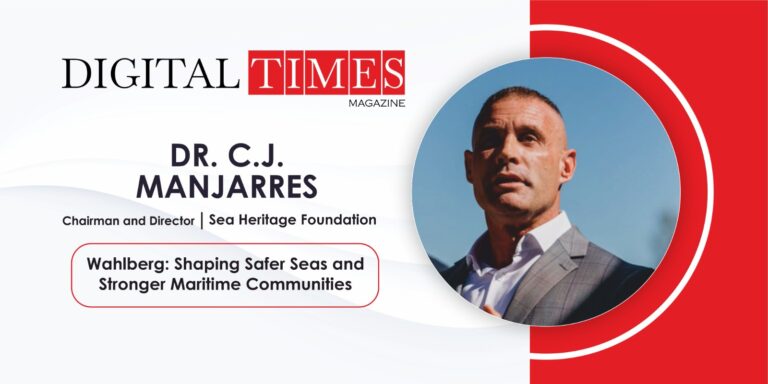
Dr. C.J. Manjarres-Wahlberg: Shaping Safer Seas and Stronger Maritime Communities
The sea has always been a place of paradox. It separates continents yet connects civilizations. It carries the weight of global commerce. It remains largely invisible to those who depend on it every day.
Beyond the horizon, ships move tirelessly through storms and uncertainty. They are guided by individuals whose decisions shape economies and safeguard lives. They keep the world moving.
In this environment, leadership is not measured by visibility or recognition. It is measured by resilience, judgment, and the ability to inspire confidence when conditions are unpredictable. Manjarres-Wahlberg demonstrates this leadership.
Among those quietly shaping the course of the maritime world is Dr. C.J. Manjarres-Wahlberg. He is Chairman and Director of the Sea Heritage Foundation. Over a career spanning more than three decades, he has navigated many of the environments that define the industry. His leadership has guided major initiatives and collaborations. He influences standards and best practices across the sector.
These include naval operations, commercial shipping, marine construction, ship repair, and marine salvage. He has worked in heritage, research, safety management, and workforce development. Together, these roles demonstrate his broad influence across maritime heritage and safety. His work continues to shape policy, training, and industry collaboration worldwide.
The Voyage That Built a Leader
For Dr. Manjarres-Wahlberg, leadership is not defined by titles or authority. Additionally, it has been shaped by decades of service and a commitment to people. Thus, his professional journey began at seventeen when he joined the Royal Australian Navy. This followed his attendance at HMAS Cerberus, the Navy’s primary junior sailor training establishment. However, an early ambition to become a pilot was curtailed by eyesight limitations. His role as a Signalman and cuff rate musician formed the foundation of his career. Consequently, on the bridge, in communications centers, and with operational teams ashore and at sea, he learned discipline and teamwork. These experiences taught him adaptability and clear communication. Flying came later and remains a life passion.
Over eleven years of full time and reserve service, Dr. Manjarres-Wahlberg participated in operations and exercises throughout the Asia-Pacific region.
Additionally, it included the 1997 Hong Kong handover.
It included Australia’s response to the Indonesian unrest in 1998.
Peacekeeping missions were conducted in the Solomon Islands and Bougainville.
Humanitarian efforts occurred in Vanuatu, and fisheries patrols occurred in the Southern Ocean.
There were several major multinational joint military exercises and cross deck postings to allied naval ships.
These experiences reinforced a guiding philosophy for his career.
Leadership is a privilege, service provides purpose, and meaningful outcomes come from people rather than position.
After his military service, he built an extensive career across maritime, offshore oil and gas, mining, and marine construction.
His work spanned Australia, New Zealand, Papua New Guinea, Singapore, Malaysia, the Timor Sea, and the Gulf of Thailand.
Moreover, his pursuit of continuous learning culminated in a Doctorate in Business Administration (Maritime Safety) in 2024.
This further strengthens his expertise in leadership, safety, human factors, and maritime management.
Currently, Dr. Manjarres-Wahlberg serves as HSE Manager and Designated Person Ashore. He is also Integration Manager for Heron Ship Repair in New Zealand. These roles reflect his operational expertise and leadership.
Steering the Future of Global Maritime Operations
Dr. Manjarres-Wahlberg has witnessed more than three decades of transformation in the maritime sector. Moreover, ships have become larger and more technologically advanced, while crews have grown smaller. They rely increasingly on automation, digital systems, and artificial intelligence.
These innovations offer substantial improvements in efficiency, safety, and decision-making.
However, they also highlight the emerging challenges they create.
Moreover, reduced crew sizes operating increasingly complex systems can contribute to cognitive overload and diminished situational awareness.
It can also lead to crew fatigue and excessive dependence on technology.
His research underscores the need to balance technological progress and industry adoption with human capability.
Another important point is the growing disconnect between the public and the maritime industry.
Moreover, shipping remains vital to global trade, yet many people ignore the chains and seafarers that sustain economies.
However, the pandemic briefly brought greater recognition to the sector’s importance, yet much of that awareness has since faded.
Looking ahead, Dr. Manjarres-Wahlberg envisions an industry that is more digital, sustainable, and automated, but one that must remain fundamentally human-centered. He believes technology should enhance professional judgment rather than replace it, ensuring that critical seamanship, communication, and problem-solving skills continue to underpin maritime excellence.
Building Safety Through Trust and Leadership
Throughout his career, Dr. Manjarres-Wahlberg has become a respected advocate for safety culture within high-risk industries. Moreover, his approach begins with a powerful principle: culture is shaped by leadership behavior rather than written policies alone.
Leaders set the tone through their actions, communication, and daily interactions.
Moreover, a strong safety culture emerges when leaders model expected behaviors and communicate transparently.
They create environments where employees feel comfortable raising concerns without fear of criticism or retaliation.
Central to his philosophy is the practice of active listening.
Moreover, frontline personnel often possess the most valuable understanding of operational risks.
Leaders must genuinely engage with their perspectives.
Listening, in his view, requires full attention, patience, and respect.
According to Dr. Manjarres-Wahlberg, care, value, and trust are the pillars of a resilient safety culture.
Moreover, when individuals feel respected and supported, they are more likely to share concerns.
They also learn from mistakes and take ownership of safe outcomes.
He believes safety is ultimately built through everyday interactions and consistent leadership behaviors.
Preserving Heritage While Creating Opportunity
As Chairman and Director of the Sea Heritage Foundation, Dr. Manjarres-Wahlberg combines his passion for maritime history with a forward-looking vision for education and workforce development. Under his leadership, the Foundation’s mission is clear: preserving maritime heritage, inspiring people, and strengthening Australia’s maritime future.
A central focus of this vision is the preservation of MV Cape Don, not merely as a museum exhibit but as a living platform for education, training, research, and community engagement. By connecting maritime heritage with modern technology and skills development, the Foundation creates meaningful opportunities for future generations while honoring those who served at sea.
The Foundation is also developing a Maritime Academy to expand training opportunities in maritime operations and related STEM disciplines. Through partnerships with educational institutions, industry organizations, defense networks, and maritime stakeholders, Dr. Manjarres-Wahlberg is helping create pathways for Indigenous Australians, veterans, and young people seeking careers within the maritime sector.
For him, preservation extends beyond protecting historical assets; it is about building capability, confidence, and long-term opportunity.
Lessons from Defense Leadership
Dr. Manjarres-Wahlberg credits much of his leadership foundation to his service in the Royal Australian Navy, Naval Reserve, and Australian Army Reserve. These experiences instilled values that continue to guide his professional life, including discipline, resilience, teamwork, and a deep commitment to supporting others.
His military background also taught him how to remain composed during uncertainty and adapt effectively when circumstances evolve faster than planned. Following his transition from military service, he experienced firsthand the challenges many veterans face when redefining their purpose in civilian life. Events during that period ultimately inspired further academic study and deepened his understanding of leadership, emergency management, safety, and human factors.
Within commercial environments, he adopts a flexible leadership style, tailoring his approach to the people, risks, and circumstances involved. Moreover, he believes trust remains the cornerstone of successful teams. Nevertheless, rank may establish authority, but leadership endures through credibility, empathy, and mutual respect.
Expanding Horizons Through Indigenous Maritime Pathways
One of Dr. Manjarres-Wahlberg’s most impactful initiatives has been his work in developing Indigenous maritime workforce pathways. Inspired by his connection to Māori culture, his maritime career, and the Sea Heritage Foundation’s commitment to social impact, he recognized a significant opportunity to address underrepresentation within the maritime workforce.
Research conducted in 2020 revealed that only 399 Indigenous Australians were employed within an industry of approximately 18,000 maritime workers. Determined to create change, he brought together partners capable of developing practical training solutions and established a competency-based learning model focused on real-world outcomes.
The result was the Get into Maritime program, delivered in partnership with TAFE NSW and The King’s Trust Australia. The initiative achieved an impressive 99 percent completion rate, significantly exceeding national Indigenous vocational education benchmarks.
For Dr. Manjarres-Wahlberg, however, success extends beyond statistics. The true objective is social and economic empowerment, creating pathways that enable individuals to secure meaningful employment, support their families, and build long-term careers within an industry that may once have seemed inaccessible.
Through this work, he continues to demonstrate that leadership can create impact far beyond business performance, helping shape stronger communities while contributing to the future of Australia’s maritime workforce.
The Human Element Behind Maritime Excellence
Dr. Manjarres-Wahlberg firmly believes that leadership, communication, and human behavior sit at the core of operational safety in high-risk environments. While the term human factors is often broadly applied, he views it as a comprehensive framework encompassing fatigue, workload, communication, system design, organizational pressures, supervision, and the environmental conditions that influence decision-making.
According to Dr. Manjarres-Wahlberg, leaders play a decisive role in shaping workplace behaviors and safety outcomes. The way leaders respond to information, interact with people, and carry themselves influences organizational culture and team performance. He considers the trust placed in supervisors, managers, and executives to be both a privilege and a responsibility that must be earned through consistent actions and sound judgment.
He also emphasizes that effective communication creates shared understanding, which in turn supports better decisions and safer operational outcomes. Authentic leadership, in his view, requires asking questions, listening carefully, challenging assumptions, and encouraging constructive dialogue. Within complex maritime environments, he regards silence as far more dangerous than respectful disagreement.
Innovation Anchored in Human Capability
As digitization, sustainability initiatives, and emerging technologies reshape the maritime sector, Manjarres-Wahlberg identifies opportunities for organizations embracing innovation thoughtfully.
Additionally, he highlights advancements such as artificial intelligence, cleaner technologies, predictive maintenance, emissions management, and enhanced operational intelligence.
These tools can improve efficiency, safety, and decision-making.
However, he also cautions against viewing technology as a solution in isolation. Successful implementation requires a clear understanding of the people and systems expected to use it. Challenges such as poorly designed interfaces, excessive independent systems, fragmented information streams, inadequate training, cybersecurity risks, skills shortages, and transition costs remain substantial concerns across the industry.
Interestingly, Dr. Manjarres-Wahlberg believes one of the industry’s greatest opportunities lies in returning to fundamental principles.
Moreover, effective communication, purposeful operationally focused training, strong seamanship, and sound decision-making remain as important as ever.
Additionally, in his view, innovation delivers lasting value only when it strengthens human capability.
Finally, it supports sustainable performance rather than creating additional complexity and operational strain.
Leading with Care, Value and Trust
Throughout his distinguished career, Dr. Manjarres-Wahlberg has been guided by a straightforward yet powerful leadership philosophy.
Additionally, he advocates leading with authenticity and intent.
He emphasizes maintaining consistency, communicating clearly, owning your mistakes, and treating others with respect and fairness.
He believes effective leadership rests on genuine care for people.
It recognizes the value of individual contributions and accountability for decisions and outcomes.
Additionally, Dr. Manjarres-Wahlberg admits when answers are not immediately available and adapts when evidence suggests a different course.
His philosophy can ultimately be distilled into three guiding principles: care, value, and trust. Thus, he believes that when people feel cared for and valued, trust naturally follows, enabling teams to achieve extraordinary results.
A Vision for the Maritime Workforce of Tomorrow
Looking ahead, Dr. Manjarres-Wahlberg envisions a maritime industry that balances technological advancement with human-centered leadership.
He sees the future belonging to organizations capable of combining digital sophistication with strong foundational skills.
Moreover, they prioritize environmental responsibility and an unwavering commitment to safety.
Workforce development remains a central focus of this vision. He advocates for greater inclusion across the industry, ensuring Indigenous Australians, veterans, young people, and individuals entering through non-traditional pathways can access meaningful opportunities both at sea and ashore. In his view, addressing workforce shortages requires broadening participation rather than relying on traditional recruitment models alone.
For the next generation of maritime professionals, Dr. Manjarres-Wahlberg encourages curiosity, continuous learning, and a commitment to mastering the fundamentals. While technology will continue to evolve, he believes qualities such as integrity, sound judgment, communication, and the ability to work effectively with others will remain timeless assets throughout any career.
Lessons from the Leaders Who Inspire
Among the many influences on his leadership philosophy, Sir Ernest Shackleton stands out as a particularly enduring source of inspiration. Dr. Manjarres-Wahlberg admires Shackleton not simply for his famous Antarctic expedition but for the leadership qualities he demonstrated when circumstances became most challenging.
He views Shackleton’s unwavering focus on safeguarding his people, adapting to changing realities, and maintaining hope amid uncertainty as timeless lessons for modern leaders. Whether managing a shipyard, leading a vessel at sea, or navigating organizational challenges, he believes resilience, adaptability, and genuine care for people remain essential leadership traits.
Finding Balance Through Learning and Connection
Outside his professional responsibilities, Dr. Manjarres-Wahlberg maintains a lifelong passion for maritime history, military history, education, and exploration. Among his more distinctive interests is collecting and reading old books, each carrying its own story and connection to the past. Wherever his travels take him, he often seeks out historic books to add to his growing collection.
He also enjoys shipwreck diving and flying, although demanding professional commitments leave limited time for these pursuits. Beyond hobbies, he places tremendous value on relationships with family, friends, and colleagues, viewing these connections as essential sources of perspective, balance, and purpose. Particularly important is the support of his partner, whom he describes as a constant source of strength throughout nearly two decades of personal and professional change.
Measuring Success Through the Success of Others
Among the experiences that bring Dr. Manjarres-Wahlberg the greatest sense of pride are those that create opportunities for others. One particularly meaningful moment occurred during the 2023 Coronation events in the United Kingdom, where he attended several events. One of the Sea Heritage Foundation’s Indigenous maritime graduates, was a guest at Westminster Abbey present at the Coronation. While the occasion itself was significant, witnessing the confidence and achievements of a young person whose opportunities had expanded through the Foundation’s work left an even deeper impression, not to mention a tear in the eye.
For him, true success is measured by the opportunities created for others. Helping individuals develop skills, enter meaningful employment, and imagine brighter futures continues to be one of the most rewarding aspects of his leadership journey.
A Lifelong Commitment to Service
When giving advice to upcoming professionals, Dr Manjarres-Wahlberg urges people not to look for that perfect time before acting; it never comes. According to him, learning happens through taking positive steps, asking questions, being ready to learn, and being open to receiving guidance from everyone in an organization.
He emphasizes building a reputation on trustworthiness, humility, integrity, and respect. Technical skills open doors, but character and relationships sustain long-term success. Additionally, one should own mistakes, learn from them, seek help when needed, and cultivate a trusted network.
Additionally, true personal and professional growth comes from doing your best.
Moreover, mistakes teach you, and applying those lessons in operational environments preserves continuous self-improvement.
Ultimately, Dr Manjarres-Wahlberg believes that a truly meaningful career is built upon pursuing a purpose greater than oneself.
Read Our recent Feature