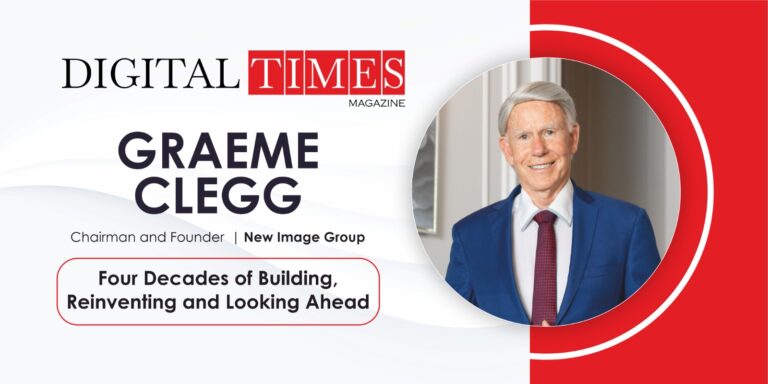
Graeme Clegg: Four Decades of Building, Reinventing and Looking Ahead
Entrepreneurship is often measured through the businesses people establish, the markets they enter and the milestones they achieve. Yet the real test of an enduring enterprise lies in its ability to keep evolving long after its original vision has taken shape. It requires more than commercial instinct; it calls for patience, sound judgement, the willingness to reinvest and the ability to recognise when yesterday’s successful formula no longer serves tomorrow’s ambitions. For Graeme, more than four decades in business have provided a close understanding of what it takes to build an organisation that can withstand change without losing sight of its purpose.
As Chairman and Founder of New Image Group, Graeme Clegg has guided the company from a straightforward entrepreneurial idea into an international enterprise spanning manufacturing, product innovation and a global network of customers and wellness ambassadors. His approach to leadership has been shaped by changing markets, difficult decisions and an enduring belief that businesses must create value beyond their immediate commercial interests. Today, his attention extends beyond the organisation’s continued growth to the development of future leaders and the role of proactive health and wellness in society.
The Decisions That Shape an Entrepreneur
Graeme’s leadership journey has not been defined by a single breakthrough or turning point. Instead, he attributes his development to the accumulation of decisions made over more than four decades, particularly those taken during uncertain or difficult periods. Experiencing favourable markets alongside challenging ones has taught him that success builds confidence, while adversity develops judgement.
Reflecting on this journey, he said, “You are shaped by hundreds of decisions, particularly the difficult ones.” That understanding has influenced the way he approaches entrepreneurship, where confidence must be balanced with the willingness to reconsider established beliefs.
He believes instinct remains an important quality for business leaders, but it must be accompanied by humility and an awareness of changing circumstances. As he explained, an entrepreneur must be prepared to make decisions without having every answer, while remaining open to changing direction when circumstances demand it. Over time, this experience has made him a more patient leader, although his appetite for progress has remained unchanged.
A Vision That Grew Beyond Its Original Ambition
When Graeme established New Image Group, the original idea was relatively simple: identify something worthwhile and create a way to bring it to people. Over the years, however, that ambition developed into something considerably broader.
New Image grew beyond a product-focused business to encompass manufacturing, innovation, international operations and opportunities for individuals from different backgrounds to build businesses of their own. The original purpose remained intact, but its reach expanded as the organisation developed its capabilities and entered new markets.
For Graeme, growth is not measured exclusively through scale. He increasingly considers the long-term significance of the decisions being made today and whether they will continue to create value for future generations. He said, “I still want us to create things that improve people’s lives, but now I think much more about what we are building for the next generation.”
This perspective has given the company’s original vision a longer horizon, placing greater emphasis on the organisation it will become and the opportunities it can create in the years ahead.
Staying Relevant Without Losing Control of the Foundations
Operating for decades in competitive markets has taught Graeme that change should not be treated as an interruption to business. New competitors, technologies, economic conditions and consumer expectations will continue to emerge, making adaptation essential to long-term survival.
He believes one of New Image’s strengths has been its ability to evolve while retaining control over important areas of its operations. Investments in manufacturing capabilities, product development, international markets and people have helped the company build a foundation for continued growth.
Reinvestment, in particular, remains an important principle in his approach. He recognises that the benefits of certain decisions may take years to become visible, but believes businesses cannot expect to become stronger if they continually extract value without putting resources back into their development.
As Graeme observed, “You cannot continually take from a business and expect it to become stronger.” For him, long-term success depends on recognising which capabilities need to be strengthened today, even when their contribution to future performance is not immediately apparent.
Leading With a Destination, Not a Fixed Route
Graeme’s leadership philosophy rests on a balance between long-term direction and the flexibility to respond to changing circumstances. He believes leaders must look further ahead than others while remaining sufficiently connected to daily operations to understand what is happening within the business.
He compares this responsibility to having a destination without becoming overly attached to the route. A clear vision gives people direction, but rigidly following a predetermined plan can prevent an organisation from recognising better opportunities.
Clarity is equally important to his approach. Employees may not agree with every decision, but they should understand the purpose behind it and the outcomes the organisation is working towards. For Graeme, leadership is ultimately about accepting responsibility when decisions are difficult and the answers are not immediately clear.
He said, “For me, leadership isn’t about having all the answers. It is about taking responsibility for the decisions when the answers aren’t obvious.”
Recognising Opportunity Before It Becomes Obvious
Curiosity plays a significant role in how Graeme identifies opportunities. His interests extend across science, technology, manufacturing, consumer behaviour and changing lifestyles, allowing him to observe developments beyond the immediate boundaries of his business.
However, he distinguishes innovation from the simple generation of ideas. The more important responsibility, in his view, is deciding which ideas deserve investment and attention. He evaluates opportunities by asking whether they address a genuine problem, improve an existing experience, can be executed effectively and align with the organisation’s long-term direction.
He also believes entrepreneurs should be willing to explore possibilities before they become widely accepted. Waiting until an opportunity is obvious often means entering a space after others have already recognised its potential.
As he put it, “Entrepreneurs must become comfortable exploring an idea while other people are still asking why.”
This willingness to investigate emerging possibilities reflects his broader belief that businesses must remain curious rather than become overly comfortable with their existing achievements.
Technology Should Make Business More Human
Changing consumer expectations are influencing how companies communicate, establish credibility and maintain relationships. Customers now have access to an unprecedented range of information and choices, making them increasingly interested in understanding the origins of products, the people behind them and the organisations they choose to trust.
Graeme sees technology as an important enabler of this changing relationship. It offers businesses new ways to communicate, educate customers and develop communities across geographical boundaries. However, he believes technological progress should strengthen human relationships rather than diminish them.
For New Image, the opportunity lies in combining digital capabilities with the personal connections that have long supported its business model. Technology should make operations more efficient and communication more accessible, but it should not remove the human element from customer engagement.
He emphasised this distinction clearly, saying, “We should use technology to make our business faster, smarter and easier, but not allow it to make us less human.”
Preparing New Leaders to Take the Company Further
As New Image has grown, Graeme has recognised that an organisation cannot remain dependent on its founder. Direct involvement in every aspect of a business may be necessary during its early stages, but it can eventually restrict the development of the wider organisation.
His approach to succession and talent development therefore focuses on giving capable people the responsibility to develop their own judgement. Rather than expecting future leaders to reproduce his decisions, he wants them to understand the principles that shaped the company while developing the confidence to take it in new directions.
He acknowledges that this requires allowing people to approach challenges differently from the way he might. Such independence is important if the organisation is to develop leadership capacity beyond its founding generation.
Graeme’s expectations for the next generation are clear. They should respect the foundations of New Image without becoming confined by its history. As he explained, “Their responsibility is to take what we have built and make it relevant to their generation.”
For him, this is the real measure of an enduring enterprise: its ability to retain its purpose while allowing new people to shape its future.
Making Difficult Decisions Without Losing Perspective
Four decades in business have inevitably brought periods of uncertainty, changing economic conditions and decisions made without a clear understanding of what might follow. Graeme believes the experience of navigating such circumstances has taught him an important distinction: a difficult present does not necessarily indicate a difficult future.
When challenges arise, he tries to separate emotional reactions from the decisions that need to be made. His approach involves identifying what has changed, determining which factors remain within the organisation’s control and establishing the next practical course of action.
He does not believe every problem needs to be solved at once. Instead, he sees leadership as a process of making the best available decision, acting on it and continuing to reassess the situation.
He said, “You don’t need to solve the next five years in one afternoon. Sometimes leadership is simply making the best next decision and then doing it again tomorrow.”
This measured approach also informs his advice to entrepreneurs. He encourages them to build businesses around genuine value rather than temporary trends, remain attentive to cash flow, continue learning and surround themselves with people willing to offer honest feedback. He also stresses the importance of protecting the business that created an opportunity rather than becoming distracted by the next one.
Above all, he considers reputation an asset that develops through consistent conduct. As he noted, “Every promise you keep adds to it. Every shortcut takes something away.”
A Future Focused on Prevention and Wellness
Graeme’s vision for the future extends beyond the conventional responsibilities of running an international business. He believes proactive healthcare will become increasingly important as populations age and healthcare systems face growing financial pressures. His perspective places considerable emphasis on prevention, immune health and the potential role of colostrum.
He refers to the historical importance attributed to colostrum by ancient civilisations and believes it deserves greater attention within contemporary wellness discussions. Through New Image, he is particularly interested in communicating the company’s approach to immune health and its range of biotech products.
The organisation has developed a global network of approximately 1.5 million customers and wellness ambassadors, according to Graeme. He also highlights the importance of scientific validation, noting that a number of the company’s products have undergone clinical trials published in medical journals, something he considers significant within the direct-selling industry.
His personal experience with the products forms part of his commitment to the business. At 87, he remains actively involved in international travel, seminars and company operations. He also says his biological age is considerably younger than his chronological age.
Graeme describes New Image as having a humanitarian purpose that extends beyond commercial activity, with prevention forming an important part of its philosophy. His comments reflect his strong conviction in the organisation’s wellness mission, although his broader claims about colostrum, immune-system dysfunction, disease prevention and ageing should be understood as his stated beliefs rather than established medical conclusions.
Building Beyond a Founder’s Lifetime
For Graeme, the future of New Image will depend on its ability to combine the experience that shaped the organisation with the ideas and capabilities of the people who will lead it next. His journey has reinforced the importance of adaptability, reinvestment, curiosity and personal accountability. Yet his most enduring concern appears to be whether the organisation can continue to create meaningful value without relying on the person who founded it.
His advice to entrepreneurs reflects the same philosophy. Build something worth sustaining, protect its reputation, remain willing to learn and give others the opportunity to take responsibility. A business, in his view, should not spend its future attempting to recreate its past.
After more than four decades of entrepreneurship, Graeme’s ambition is therefore not simply to preserve what he has built. It is to ensure that New Image continues to evolve, that its people have the freedom to shape its direction and that its original purpose remains relevant to generations still to come.
Also read: Graeme Clegg: Four Decades of Building, Reinventing and Looking Ahead